By Jock Merriman. Fifth-generation Merino woolgrower, founder of Sir W. Merino. Australian Merino since 1880.
I played rugby for years, which means I owned a lot of polyester. Training kit, base layers, the lot. All of it went in the wash after one session because it had to. Leave a sweaty polyester shirt in a bag overnight and by morning it's got opinions.
It took me a long time, and a career around sheep, to ask the obvious question. Why does the shirt smell, when the sweat itself barely does?
Sweat isn't the problem. What lives on it is.
Fresh sweat is mostly water and salt. The smell comes from bacteria on your skin breaking down compounds in that sweat. So the real question about any athletic shirt is how much moisture and how many bacteria it leaves hanging around your skin.
Polyester is a plastic. It absorbs almost no water, well under one per cent of its weight. Moisture sits on the surface as liquid, against you, warm and damp. That's a good place for bacteria to work. Researchers in Belgium found in 2014 that polyester shirts held noticeably more of the bacteria behind the sharpest body odour than cotton ones did. Polyester also tends to hold odour compounds in the fabric, which is why a shirt can still smell after a wash.
What Merino does differently
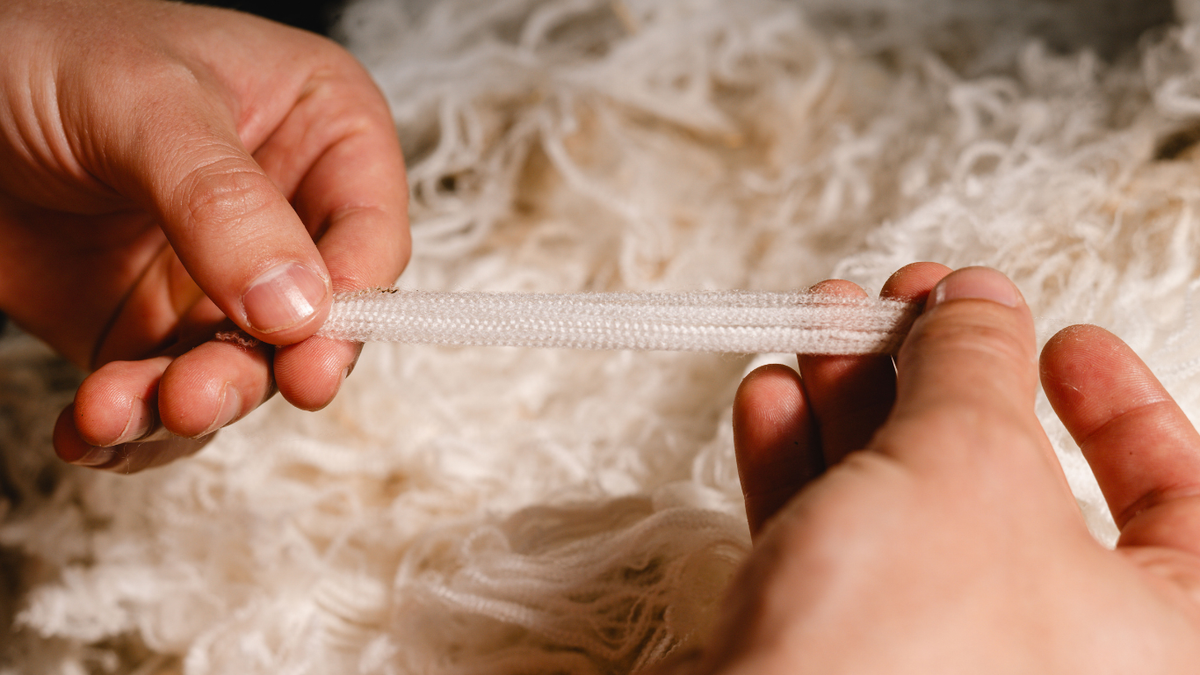
A Merino fibre is built nothing like a plastic thread. The inside of the fibre is hydrophilic, so it pulls moisture vapour in. The outside is covered in overlapping scales and is far more water-repellent. Vapour moves into the fibre and away from your skin before it condenses into liquid. Wool can hold roughly a third of its own weight in moisture before it feels wet.
Two things follow from that. Your skin stays drier, so the bacteria have less to work with. And a good share of odour molecules get bound up inside the fibre rather than sitting on the surface, where they're released again when the shirt is washed and aired.
One thing I'd correct, because it gets repeated a lot: lanolin isn't the reason. Lanolin is washed out in scouring long before a fibre becomes a shirt. It's the structure of the fibre doing the work.
What this looks like in real training
I'd rather quote someone other than me. A customer who has played rugby for thirty years, and who goes by Silver S. in his review of The Cassius, ran his own test: five dripping-wet training sessions, hung the shirt up to dry each time, no washing in between. His words: "Each time I would go back to wear it and it was just as fresh as the first time I wore it. I stretched it to 7 wears. No smell."
That's one man's test, not a laboratory trial, and I'd be telling you the same if it were a worse result. But it matches what I see in the fibre, and it matches the pattern in the reviews that come through.
Where I'd be careful
Merino isn't a force field. A hard summer session in Austin, where I live, still leaves a shirt that wants a wash, and I wash it. Seven wears is a ceiling for one person's training, not a promise. A few things that help:
- Hang the shirt up to dry after each session. Don't bag it damp.
- Rotate two shirts, so each gets a full day to air out.
- When you do wash, go cold and gentle, and dry it flat or on a hanger.
Do that and you'll wash far less than you do now. That's easier on the shirt, easier on the water bill, and kinder to the planet, since synthetics shed microfibres every time they go through a machine.
The practical bit for training
The Cassius is the one I built for this. It's light, it fits close without clinging, and it works as a base layer when the weather turns, which around here it does by the afternoon. Pair it with The Bruce over the top for the cooler mornings and you've covered a good 20-degree swing without changing shirts.
I pack every order myself here in Austin, and there's free US shipping and 30-day free returns. If it isn't for you, send it back and I'll sort it.
My family has grown Merino in Boorowa, New South Wales, since 1880, and the fibre has barely changed in that time. It didn't need to. The sheep had the engineering done long before the rest of us arrived.
— Jock Merriman, Founder · 5th generation