How Merino Wool Is Grown: From Paddock to Shirt | Sir W. Merino
"You can't make great wool in a factory. You make it on land, over generations, with sheep that have spent their lives on the same country." — Jock Merriman

The Land
The wool in every Sir W. shirt comes from the grazing hills and plains, of the most prestigious woolgrower in history; Australia. Millions of acres of sheep pasture that have allowed Merino sheep to thrive since their introduction to Australia in 1797.
The Merriman family have bred and grown Merino wool since the late 1800's. The bloodlines continue and every year aim to improve the quality of fiber that is produced, a dedication to excellence has been a constant thread over the last century and half.
This continuity matters more than it sounds. Wool quality is not a property of the sheep alone — it's a property of the country the sheep have lived on for generations. Mineral content in the soil, rainfall patterns, the specific grasses that grow, the cold winters and the hot summers — all of it compounds into a fibre that can't be replicated by any other clothing fibre.
The Flock
Our flock is purebred Merino, descended from the original lines Sir Walter Merriman built up after receiving his first sheep in 1903. Modern selective breeding has refined the wool over the last half century, but the core genetics trace back unbroken to that original flock.

The genetic pool for the Australian Merino flock is a pivotal anchor that separates Australian wool from the rest of the world. The fineness, length, color and strength sets our wool on a pedestal as the best in the world.
Australian Merino simply cannot be matched for fineness, softness and quality.
What Micron Actually Means
A micron is one-thousandth of a millimetre. It measures the diameter of an individual wool fibre.
For context:
- Traditional sheep wool (the wool that gave wool its scratchy reputation): 30+ microns
- Standard Merino: 22–24 microns
- Fine Merino: 19–21 microns
- Superfine Merino — what we use: 17.5-18.5 microns
- Ultra-fine Merino (rare, exclusive to high-end suiting): 15–17 microns
The difference matters because the human skin's pain threshold sits around 25 microns. Anything thicker than that pokes the skin instead of bending against it, and triggers the itch response. Anything below it bends against the skin like cotton or silk.
At 17.5 microns, our wool is finer than human hair. It sits against your skin and behaves more like a soft natural fibre than what most people think of as wool.
This is the single most important fact about merino, and it's the one most brands either don't know or don't bother explaining. The wool that itches your grandfather's jumper and the wool in a Sir W. shirt are barely the same material.
How We Get From Sheep to Shirt
Once a year, Merino sheep are shorn- it's how we collect the wool. A team of shearers comes out from the nearest town and works through the flock. The wool is gathered, sorted, graded, and pressed into bales.

Once shorn and baled, the wool moves the next stages of the wool processing chain.
Scouring - This washes the raw fleece to remove lanolin, dirt, and vegetable matter. From there, it is now clean and ready to be combed.
Gilling - However, before it can be combed, we need to straighten the fibres to be teh same direction, gilling does this by 'brushing' the wool to be in a uniform direction.
Combing - This further straightens out the wool fibers while removing more vegetable matter and any 'shorter' fibers that might reduce the quality of the yarn.
Spinning - The purpose of spinning is to insert sufficient twist into the yarn to bind the fibres together, so it is strong enough to withstand the strains of knitting and wear.
Knitting - Knitting is a fabric-forming technology that has been used for thousands of years. It can be used to create fabrics, which can come off the machine as fabric to be cut or as shaped pattern pieces and whole garments.
Why We Don't Blend
Most "merino" garments on the market are blends. A typical merino t-shirt sold by an outdoor brand is 80% merino, 20% nylon or polyester. The blend cuts cost, increases durability for high-abrasion use, and reduces the wool's natural performance.
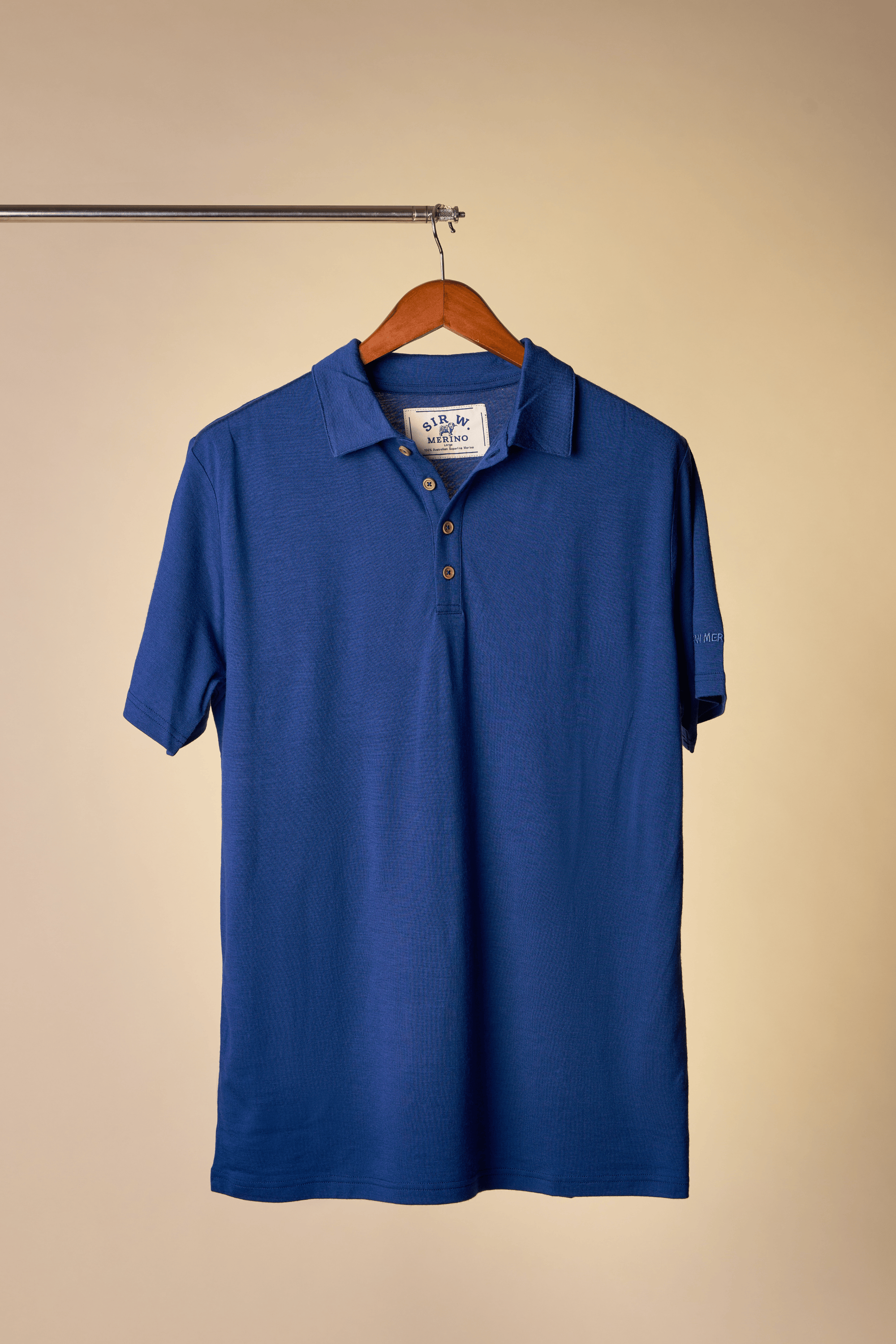
We don't blend. Every Sir W. shirt is 100% merino. No synthetic fibres, no plastic blends, no shortcuts.
The trade-off is honest: a 100% merino shirt requires slightly more care than a polyester blend. It doesn't tumble dry. It pills slightly more in the first wash. But it also:
- Breathes the way only natural fibres can
- Sheds zero microplastics into your laundry or the ocean
- Biodegrades completely at the end of its life
- Feels, frankly, better against skin than anything synthetic can replicate

The Sustainability Bit, Honestly
Wool is having a moment in sustainability conversations, and not all of the claims hold up to scrutiny. Here's what's actually true:
True: Merino wool is renewable. Sheep grow a new fleece every year. The same animal produces wool for ten or twelve years of its life.
True: Merino is fully biodegradable. A wool shirt buried in soil decomposes completely within twelve months.
True: Wool requires no plastic micro-fibre to be present anywhere in the supply chain.
True: Sheep grazing, done well, can be carbon-neutral or even carbon-negative because of the role healthy pasture plays in soil carbon sequestration.
Honest caveat: Sheep produce methane, but methane has a natural 9 year life cycle. Carbon is the real danger, and grow the grass that sequesters carbon through natural sequence farming.
We'd rather be useful than virtuous-sounding. Merino is one of the most genuinely sustainable fibres available for the kind of garments we make. It's not perfect but nothing is.
Featured collection
Spring Collection '26