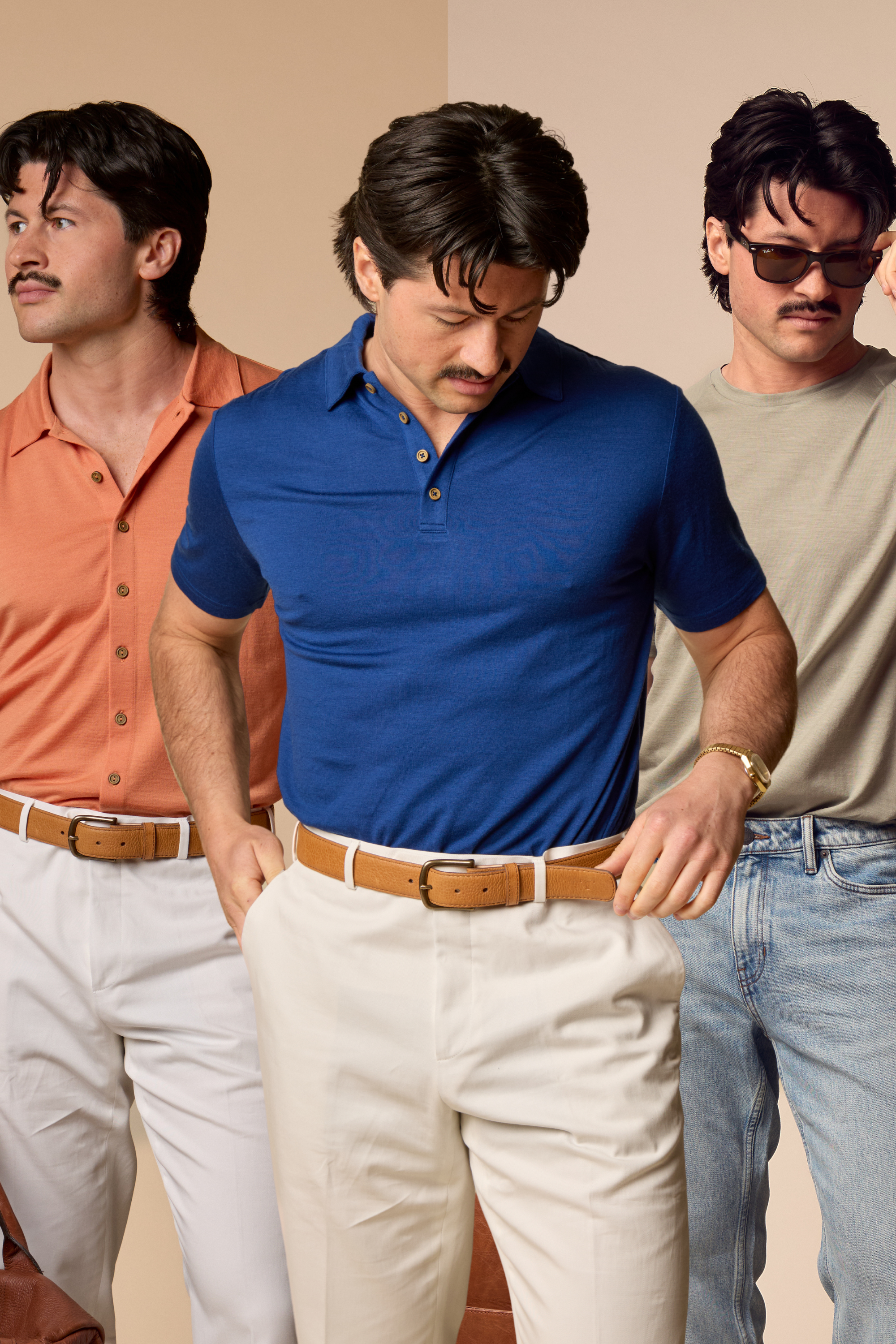
The Fifteen-Hour Shirt: What a Long-Haul Flight Actually Does to What You're Wearing
Cabin air runs drier than most deserts, and you sit in it for the better part of a day. Here is what fifteen hours at altitude does to a shirt — and why the fibre matters more at 38,000 feet than almost anywhere else on the itinerary.
By Jock Merriman, Founder of Sir W. Merino
The cabin is a desert with seatbelts
Austin to Sydney is the flight I know best. Two aircraft, roughly twenty-two hours of it in the air, and by the second leg I have usually stopped pretending I am a person and started behaving like cargo.
Most people blame the seat. The seat is not innocent, but it is not the main offender either. The main offender is the air.
At cruise altitude, the cabin is pressurised with outside air drawn from around 38,000 feet, where there is essentially no water vapour to speak of. Once it is warmed and circulated, relative humidity in the cabin typically settles somewhere between 10 and 20 per cent, and in some cabins it measures lower still. For comparison, the Sahara averages around 25 per cent. You are not flying through a desert. You are flying through something drier than one, in a chair, for fifteen hours.
That is the environment your shirt is being asked to work in. And most shirts are not being asked politely.
Three climates, one journey
The other thing nobody accounts for is how many different climates a single flight contains.
You leave the house in Austin in August, which is its own act of endurance. You queue in a terminal that is over-air-conditioned to the point of hostility. You board, and the cabin sits warm on the ground and then turns cold at altitude. You sleep badly, wake up clammy, and land in Sydney where the air outside the terminal is thick and heavy and entirely unlike anything you have experienced since breakfast the previous day.
A cotton shirt handles the first climate reasonably and the rest of them poorly. It takes on your sweat at the gate, holds it, and then you carry that dampness into a cold cabin for the next eight hours. Polyester dries faster but has no interest in regulating anything, and by hour six it has begun to announce your presence to row 42.
The fibre that copes is the one that buffers — that can take on moisture without broadcasting it, and let it go again when conditions change.
What superfine merino is actually doing up there
Wool is hygroscopic. It absorbs water vapour into the core of the fibre rather than simply carrying it on the surface, and it will take on somewhere in the region of thirty to thirty-five per cent of its own dry weight in moisture before it begins to feel wet against the skin. Most synthetics feel damp once they have absorbed under ten per cent.
This is not a coating and it is not a treatment. It is the structure of the fibre, and it does not wash out.
Two consequences matter on a long flight. The first is that the shirt acts as a buffer: it takes on the moisture you produce during the anxious sprint to the gate and releases it slowly through the dry hours that follow, rather than sitting cold and wet against you the whole way. The second is subtler. When wool absorbs moisture vapour, the reaction releases a small amount of heat — the heat of sorption. It is not a heater. It is enough, though, to take the edge off that specific misery of being slightly damp in a cold cabin, which is the sensation most people actually mean when they say flying makes them feel awful.
Our shirts are knitted from 17.5 to 19 micron Australian merino, the superfine range. That number matters here for a plain reason: fibre this fine sits softly enough against skin to be worn for a full day without complaint. The old itch problem is a coarseness problem — wool above roughly 30 microns is what people remember from a school jumper. Under about 19 microns, it simply does not register.
One correction worth making, because it gets repeated everywhere: merino is not finer than cotton. Cotton fibre runs about 15 to 20 microns, the same range or finer. Merino does not win on fineness. It wins on temperature regulation, moisture handling and odour resistance — which is precisely the trio a long-haul flight tests.
The odour causing bacteria
The reason a merino shirt does not smell after a day in transit is not lanolin. Lanolin is scoured out of the wool long before it reaches a mill, and any brand telling you otherwise is telling you something that is not true.
The real explanation is the fibre's structure. Wool absorbs moisture vapour into the fibre interior, away from the surface, which leaves less free water sitting on the outside for odour-producing bacteria to work with. The keratin structure itself is also less hospitable than a smooth synthetic filament, which is effectively a plastic surface that bacteria find very comfortable indeed.
Practically, this means the shirt you board in is still the shirt you can walk through arrivals in. Which is the entire point.
What I actually fly in
Three shirts, one bag, and no ambition to be photographed on arrival.
The Cassius goes on for the flight itself. It is the athletic tee, cut close, and it is the layer that does the moisture work while I try and fail to sleep. The Cassius, $90.
The George is the polo, and it is what I change into an hour before landing when I want to look like a man who has made an effort rather than a man who has been folded into a seat for half a day. It also carries me straight into a dinner I did not plan for.
The Bruce is the short-sleeve button-up, and it is what goes on the moment I hit Sydney humidity. Collar, buttons, short sleeves, no fuss — the shirt for arriving somewhere warm and still looking dressed. The Bruce, $125.
If you want all three, The Starter Set is $290 — $35 off the three bought separately — and it is, not coincidentally, exactly the kit I take to Australia.
The bottom line
You cannot do much about the seat, the queue, or the man in 42B. You can do something about the fact that you are spending fifteen hours in air drier than the Sahara wearing a fibre that was never designed for it.
Superfine merino will not make the flight short. It will make you arrive as a person rather than as luggage — dry, unremarkable in the best sense, and not obliged to change before you speak to anybody. On a journey where almost nothing is in your control, it is one of the few decisions that reliably pays you back.
Frequently asked questions
Is merino too warm to fly in?
No, and this is the most common misunderstanding about the fibre. Merino regulates rather than insulates — it buffers moisture and moderates temperature swings in both directions. A superfine merino tee is comfortable in a warm terminal and a cold cabin, which is exactly why it suits a journey that contains both.
How many days can I wear the same merino shirt while travelling?
Most people find two to three days of ordinary wear entirely reasonable, and considerably longer if you air the shirt overnight. The limit is usually visible marks rather than odour. Airing it on a hanger in the bathroom while you shower does most of the work.
Does merino wrinkle in a suitcase?
Far less than cotton or linen. Wool fibre has a natural crimp and returns towards its original shape, so creases from packing tend to drop out within an hour of hanging. It is not a formal-shirt press finish, but you will not be hunting for an iron in a hotel room at midnight.
Is merino warmer or cooler than cotton?
Neither, exactly, and that is the point. Cotton is a poor regulator: it absorbs sweat, holds it, and then chills you when the temperature drops. Merino moves moisture as vapour and buffers the swings, so it feels appropriate across a much wider band of conditions rather than excelling at one.
How do I wash a merino shirt on the road?
Cold water in a basin, a small amount of gentle detergent, press the water out with a towel rather than wringing, then dry flat or on a hanger away from direct heat. It dries faster than cotton. Most trips will not require it, which is rather the argument for packing merino in the first place.
Jock Merriman is the founder of Sir W. Merino and a fifth-generation Australian wool farmer. His family has been growing Merino wool since 1880, and the brand takes its name from his great-grandfather, Sir Walter Merriman, who founded Merryville Stud — in Boorowa, NSW — in 1903 and was knighted in 1954 for his contribution to the Australian Merino industry. Jock lives in Austin, Texas, where Sir W. Merino is designed; the shirts are manufactured in Shanghai by Diyang, a factory specialising in fine merino apparel for premium brands.