One Bag, One Week: The Merino Travel Wardrobe
Three shirts, a carry-on, and seven days. The fibre that makes it possible — and the honest science behind why you can wear it for days running and still walk into dinner.
By Jock Merriman, Founder of Sir W. Merino
I have stood at more airport check-in desks than I care to count, watching a fellow traveller wrestle a bursting case onto the scales while the attendant points, apologetically, at the number. I have been that man. For years my packing logic ran on fear: a shirt for every possible weather, every possible dinner, every possible spill. I would land with a suitcase full of clothes I never wore and a back sore from carrying them.
The fix, when it finally arrived, was not a better packing cube or a cleverer folding technique. It was the fabric. Once I started travelling in superfine merino, the maths of the trip changed. Three shirts now cover a week — and I land lighter, in every sense.
Why cotton struggles on the road
Cotton is a fine traveller's fabric in theory and a difficult one in practice. It creases the moment you sit on a plane and holds that crease until an iron intervenes. It absorbs moisture readily but is slow to release it, so a humid afternoon leaves you damp and stays that way. And after a single warm day, cotton tends to announce where it has been — it holds odour, and a second wear is rarely an option without a wash.
None of this is a knock on cotton's comfort. It is simply the wrong tool for a one-bag week, where every shirt has to pull a double or triple shift.
What merino actually does differently
Let me be precise, because there is a lot of loose talk about wool. Superfine merino is not magic, and it is not finer than cotton — both fibres live in a similar range, roughly 15 to 20 microns, and ours sits at a superfine 17.5 to 19. Fineness is not the point. What merino does better than almost anything else is manage the gap between your body and the weather.
It regulates temperature. The same shirt that keeps you warm on a cool Lisbon morning breathes freely when the afternoon turns hot. Merino's crimped fibres trap air when you need insulation and let it move when you don't, which is why one shirt can genuinely carry you from a chilly departure to a sweltering arrival.
It manages moisture before you feel it. Merino is hygroscopic — it draws water vapour into the core of the fibre and holds it there, away from your skin, releasing it slowly into the air. In plain terms: it deals with perspiration as vapour, before it ever becomes the damp, clammy feeling that ruins a long travel day.
It resists odour. This is the part most people get wrong, so I will be careful. The odour resistance has nothing to do with lanolin — that natural grease is scrubbed out during scouring long before the wool becomes cloth. The real explanation is the structure of the fibre itself and the keratin it is made of, which manages moisture and is far less hospitable to the bacteria that turn sweat into smell. The practical upshot is the only bit that matters at 30,000 feet: you can wear a merino shirt for two or three days running and it stays fresh.
It refuses to crease. Those same springy, crimped fibres recover their shape. Roll a merino shirt into the corner of your bag, shake it out at the hotel, and it looks like you meant to wear it.
The one-bag week, in three shirts
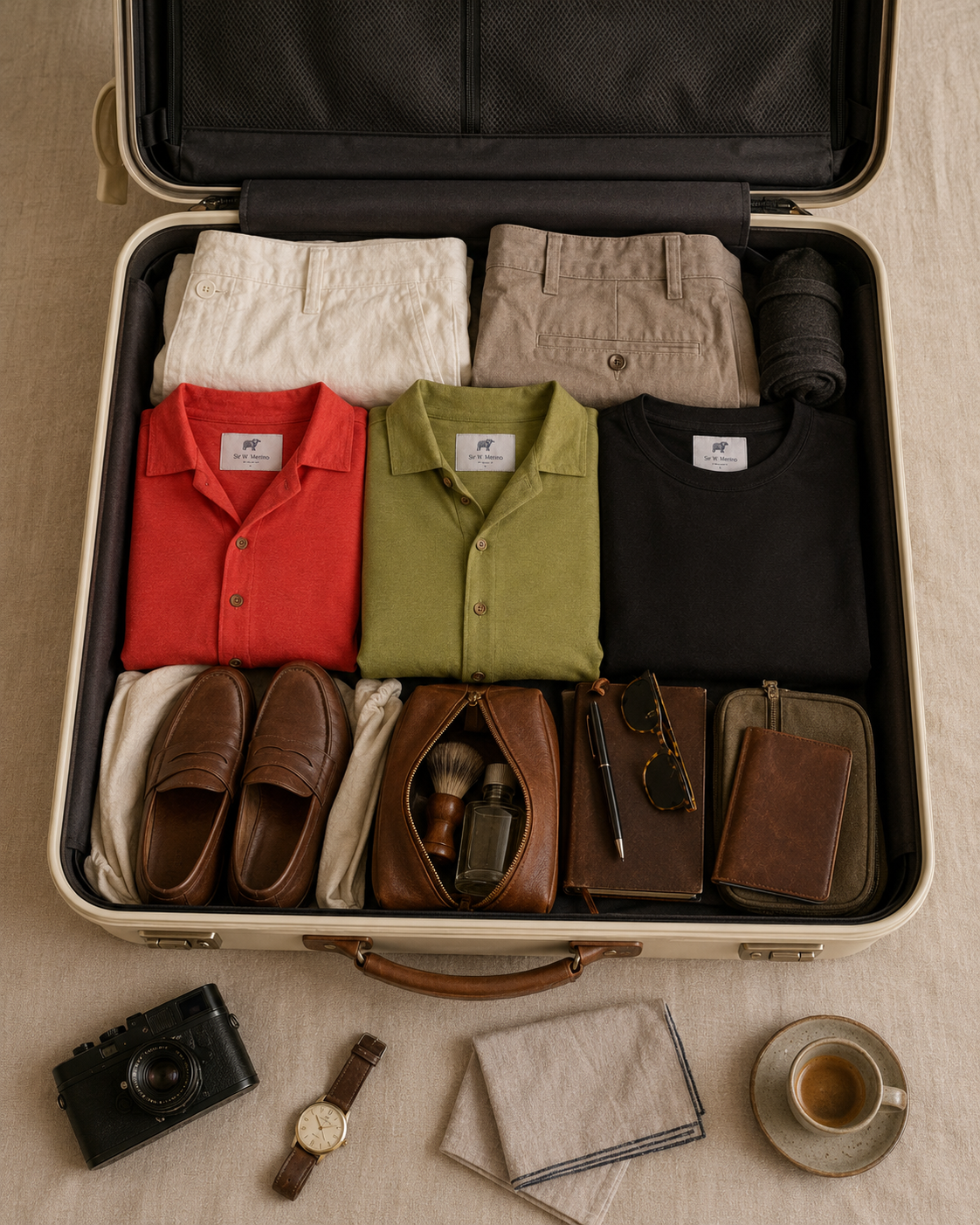
Here is the wardrobe I actually travel with. It fits in a carry-on with room to spare, and it has yet to let me down.
The Cassius — the athletic tee — is the travel-day shirt and the workout shirt. It is the one I fly in, walk a new city in, and wear to the hotel gym, and it handles all three without complaint.
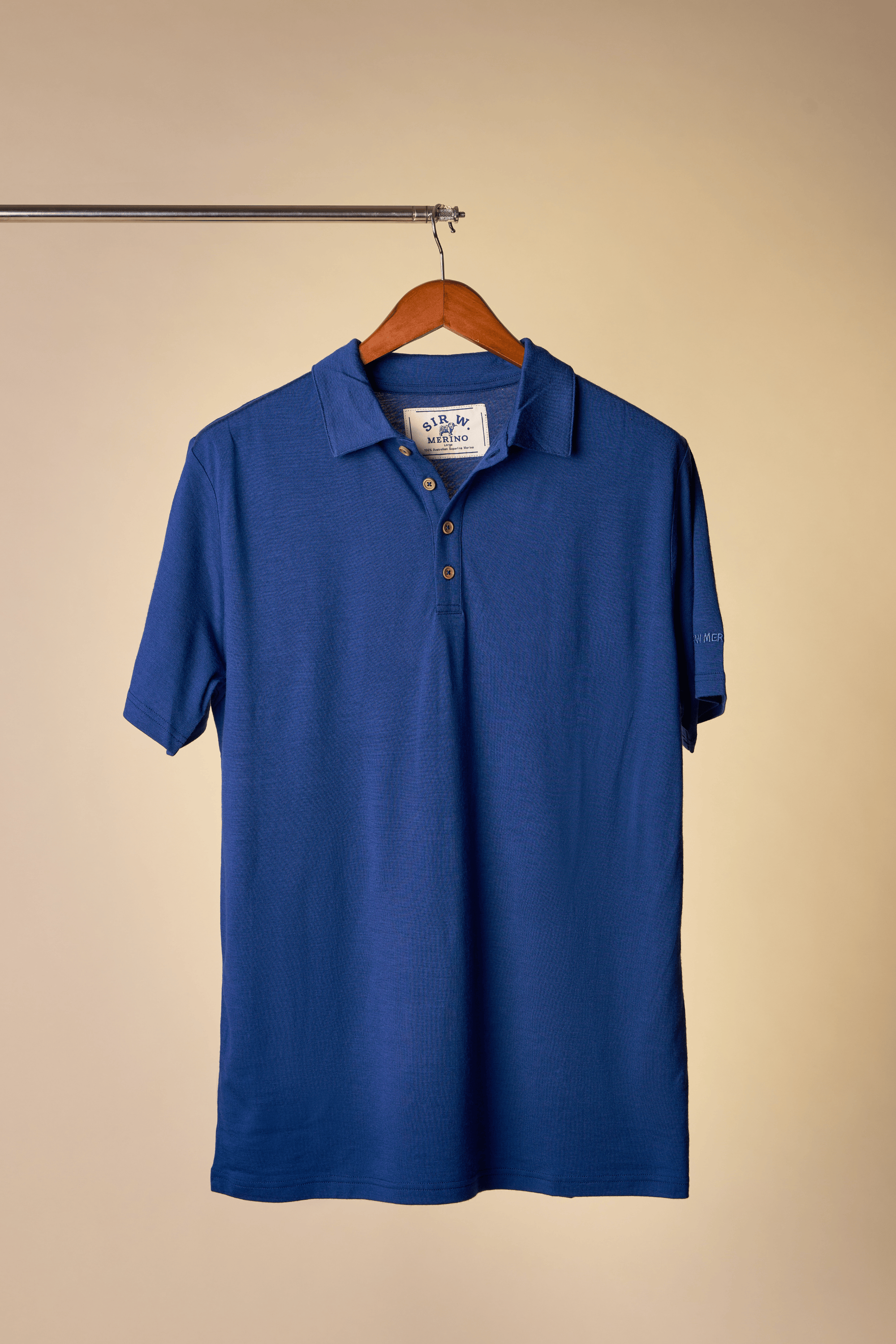
The George — the polo — is the daytime shirt. Smart enough for a lunch meeting, easy enough for an afternoon of wandering, it is the piece that does the most quiet work on any trip.
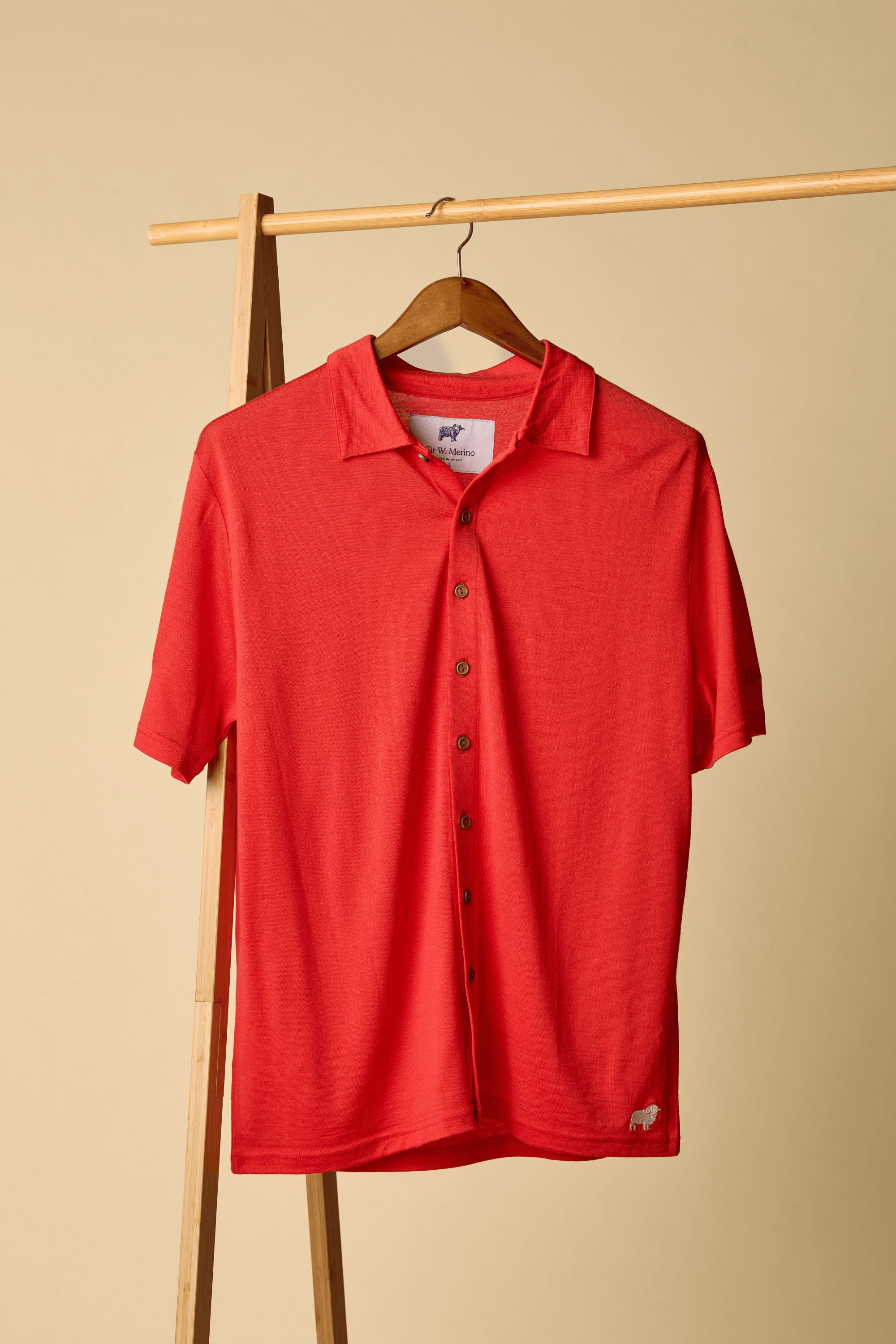
The Bruce — the short-sleeve button-up — is the dinner shirt. Buttoned and worn straight, it reads as considered the moment you walk into a restaurant, and it is the shirt that makes a one-bag trip look intentional rather than improvised.
Rotate the three, rinse one in the basin at night, hang it over the bath, and it is dry and ready by morning. That is the whole system. No iron, no laundry detour, no overpacked "what if" shirts riding along for the week unworn.
The bottom line
Travelling well is mostly about carrying less and worrying less. Merino lets you do both at once: a smaller bag, fewer decisions, and shirts that look right whether it is your first wear or your third. Pack three good shirts instead of ten anxious ones. You will not miss the other seven.
Ready to build your own one-bag week? The Starter Set brings all three shirts together — The Bruce, The George and The Cassius — for $290, which is $35 off buying them separately. Or start with The Bruce, the short-sleeve button-up that earns its place in every bag.
Frequently asked questions
How many days can I really wear a merino shirt before washing it?
In normal travel use, two to three days is comfortable, often more. The fibre's structure manages moisture and discourages odour-causing bacteria, so a shirt that would be done after one day in cotton keeps going. A quick airing overnight resets it.
Is merino too warm for summer travel?
No. Merino regulates temperature in both directions — it breathes and moves moisture away in the heat just as it insulates in the cold. Our superfine 17.5-19 micron weight is built for warm-weather wear, which is exactly why one shirt can handle a trip that crosses climates.
Will it itch?
Coarse wool itches; fine wool does not. The threshold sits around 30 microns. At a superfine 17.5 to 19, our merino is well under it and sits soft against the skin all day.
How do I wash it on the road?
Rinse it in the sink with a little soap, press out the water without wringing, and hang it to dry overnight. It dries faster than cotton and needs no iron — shake it out and the creases fall.
Where are Sir W. shirts made?
They are designed in Austin, Texas and manufactured in Shanghai by Diyang, a factory that specialises in fine merino apparel for premium brands. We would rather name our maker than dress it up.
Jock Merriman is the founder of Sir W. Merino and a fifth-generation Australian wool farmer. His family has been growing Merino wool since 1880, at Merryville Stud — founded by his great-grandfather Sir Walter Merriman in 1903 — in Boorowa, NSW. Jock lives in Austin, Texas, where he designs shirts cut from the wool he grew up around.