Merino Wool in Summer: Why It Works at 100 Degrees
It's July in Austin, the pavement is radiating, and I'm wearing wool — on purpose. Here's what the fibre is actually doing under there.
Every July I get a version of the same message: mate, it's 100 degrees — surely this is the month the wool shirts go in a drawer. It's a fair question, built on a reasonable assumption: wool is the winter fibre, the jumper fibre, the thing your grandmother knitted. And for coarse wool, the assumption is mostly right.
But superfine merino isn't that wool, and heat isn't really the enemy shirts fail against. Sweat is. Once you look at what a shirt has to do when you're sweating, wool stops sounding like a prank and starts sounding like the obvious answer.
The two ways shirts fail in the heat
Hot-weather shirts fail in two familiar ways. The first is cling. Cotton is comfortable dry, but it absorbs liquid sweat and holds it — by mid-morning the shirt is heavier, damp and stuck to your back, and a wet shirt pressed flat against skin can't breathe at all. The second is smell. Polyester barely absorbs anything, so sweat sits on your skin until the shirt films over it, and by afternoon the bacteria have done their work.
Notice that neither failure is about temperature. Both are about moisture management — which happens to be the thing wool has spent a few million years getting right.
Merino runs a small cooling engine
Merino is hygroscopic: the fibre takes up moisture as vapour, before it ever beads into liquid on your skin, and can hold up to about 30% of its own weight without feeling wet. That moisture then evaporates from the fibre rather than from you — and evaporation carries heat away with it. In practice the shirt is running a slow, continuous evaporative cooler between your skin and the air. (We went deep on the mechanics in Where Your Sweat Goes.)
Two structural details finish the job. Fine merino has natural crimp — a built-in wave in the fibre — which holds the knit fractionally off your skin, so air keeps moving even when you're damp and the shirt doesn't cling. And because the fibre is keratin, the same protein family as your hair, a day's sweat doesn't turn into a smell by lunchtime. That's the fibre's structure at work, not lanolin — lanolin is washed out long before spinning.
One honest clarification, because it gets repeated wrongly all over the internet: merino isn't cooler than cotton because it's finer. Cotton fibres sit in the same fineness range as fine merino. The difference is behaviour — merino moves moisture as vapour and stands off the skin; cotton drinks liquid and clings.
The other side of the door
Here's the part nobody markets: a Texas summer isn't one climate, it's two. The street is 100°. The meeting room is 68° and blowing. Most summer clothing is engineered — barely — for the first and does nothing about the second, which is why half the office keeps a fleece on the back of a chair in July.
Because merino buffers moisture and temperature in both directions, the same shirt that manages the pavement takes the edge off the air conditioning. It's not insulation in the winter-coat sense; it's a thermostat. One shirt, both climates, no costume change.
THE OFFICE-IN-JULY SHIRT — SHOP THE GEORGE →
An honest note about 100 degrees
Nothing makes 100° pleasant. Not merino, not linen, not the technical shirt with the mesh panels. If a brand tells you its shirt will keep you cool on a July afternoon in full sun, it's selling you weather control, and nobody sells that.
What a shirt can honestly promise is to manage the consequences of heat: keep sweat moving instead of pooling, keep fabric off your skin instead of stuck to it, and finish the day without announcing itself. That's the whole case — and it's why merino sheep, wearing considerably more of this fibre than you ever will, stand in Australian paddocks through 100° summers without much complaint. The fibre was solving this problem long before we cut it into shirts.
The bottom line
Heat doesn't defeat shirts; sweat does. Cotton holds it and clings, polyester ignores it and smells, and merino moves it — off your skin, through the fibre, into the air, taking heat with it as it goes. Add the crimp that keeps the knit breathing and a protein that doesn't feed odour, and wool in July stops being a contradiction. It's the correct tool, used in the month it was grown for.
THREE SHIRTS FOR BOTH CLIMATES — THE STARTER SET ($35 OFF) →
FAQ
Isn't wool a winter fabric?
Coarse wool, knitted heavy, mostly is. Superfine merino (Sir W. shirts are 17.5–19 microns) knitted into a light single jersey behaves differently: it moves moisture as vapour, breathes through its crimp, and regulates temperature in both directions — which is why it works in July as well as January.
Is merino cooler than cotton in summer?
Not because of fineness — cotton fibres are in a similar fineness range. The difference is moisture behaviour. Cotton absorbs liquid sweat, gets heavy and clings flat to your skin. Merino takes moisture up as vapour, releases it by evaporation, and its crimp keeps the fabric standing slightly off your body, so it stays drier-feeling and keeps breathing.
Will a merino shirt smell if I sweat in it?
Far less than a synthetic. Odour resistance comes from the fibre's keratin structure and the way it keeps moisture away from skin bacteria — not from lanolin, which is scoured out during processing. Most wearers air a merino shirt overnight and wear it again.
What weight of merino should I wear in the heat?
Light single-jersey knits in the superfine range — under the ~19-micron mark where wool stays soft against skin. All three Sir W. shirts are cut from 17.5–19 micron merino for exactly this reason: fine enough for summer skin contact, structured enough to breathe.
Can I wear these to the office in a Texas summer?
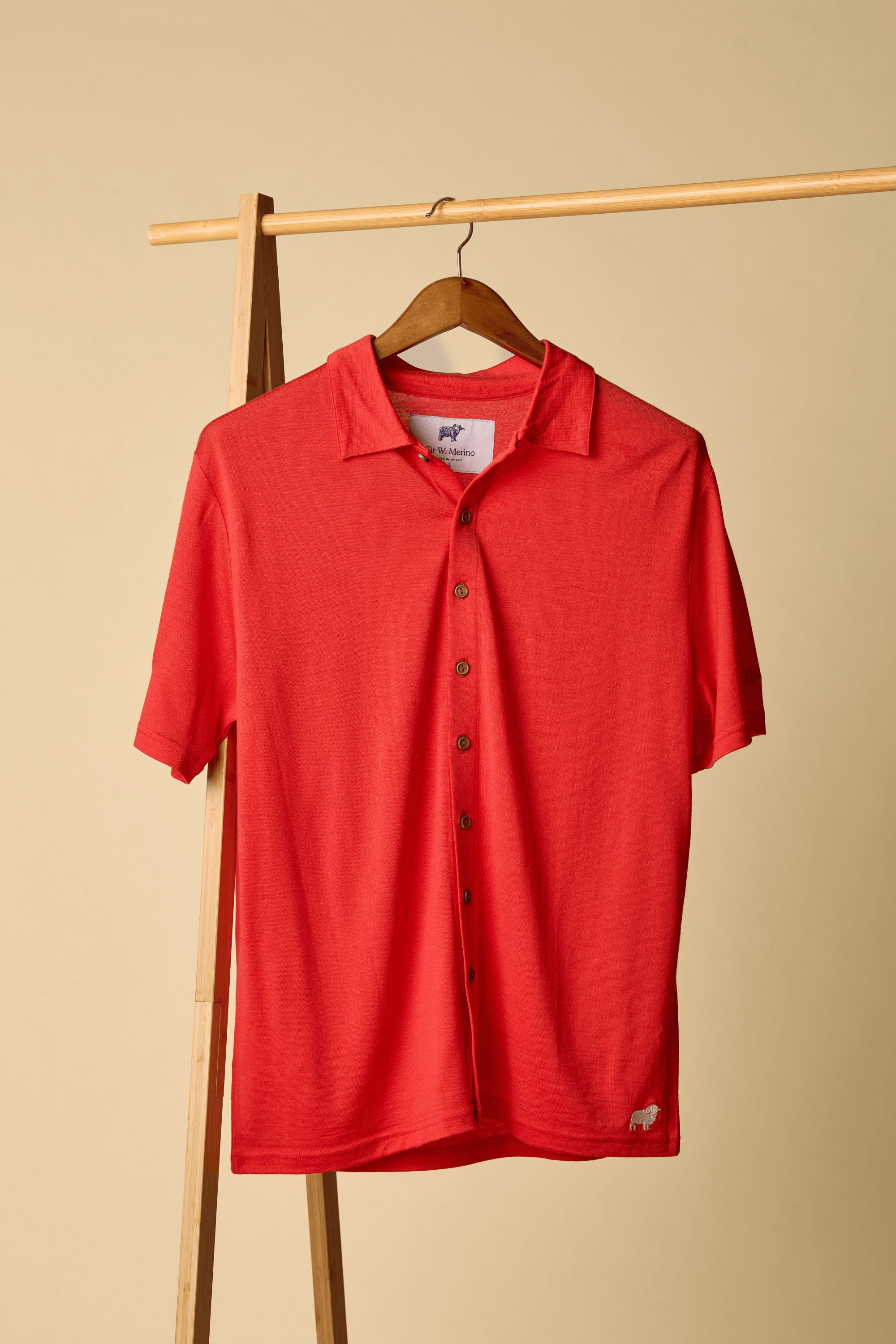
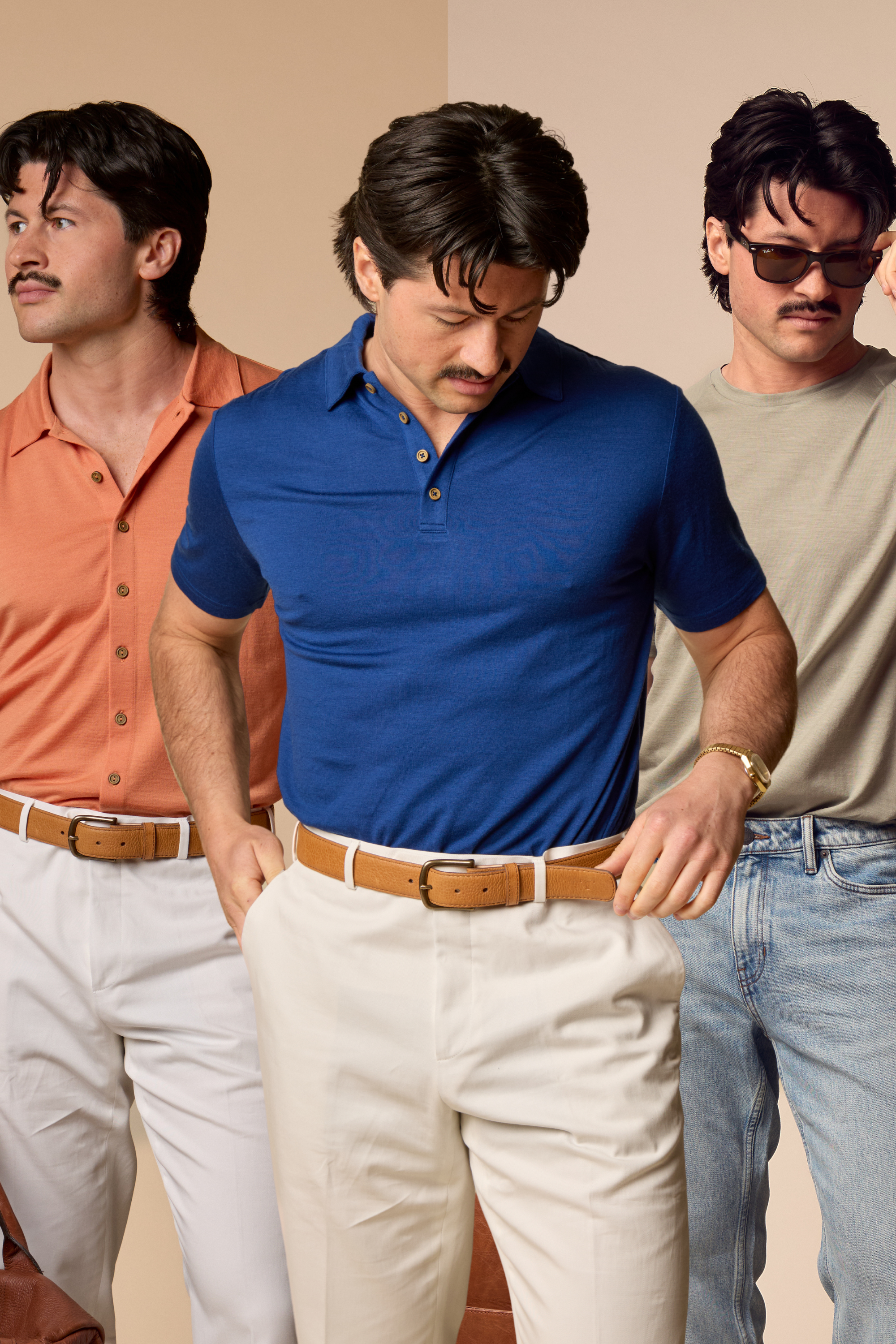
That's the use case. The George is a polo that reads office-appropriate, and The Bruce is a short-sleeve button-up that gives you a collar without a jacket. Both handle the 100° commute and the 68° air conditioning with the same fibre.